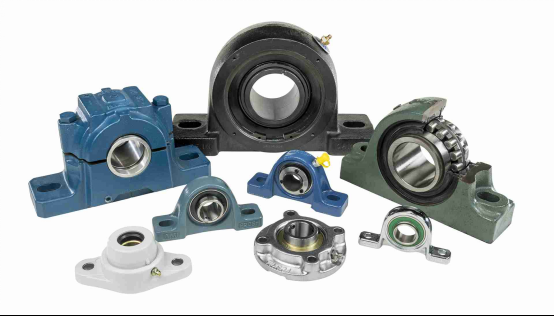
The core working principle of a ball bearing seat is “bearing support + displacement constraint + load transmission + auxiliary heat dissipation/protection.” Through its cooperation with the ball bearing, it stably constrains the bearing’s rotational motion within a preset range, while simultaneously bearing and transmitting loads during mechanical operation, reducing vibration, and ultimately ensuring the precise and efficient operation of the equipment.
Specifically, it can be broken down into the following four key components, explained one by one in conjunction with their structure and function:
1. Core Cooperation: Fixing the Bearing and Limiting the Movement Trajectory
The core of a ball bearing is “inner ring rotating with the shaft, outer ring fixed/limited.” The primary function of the bearing housing is to fix the outer ring of the bearing (or constrain its displacement through a positioning structure), ensuring that the bearing’s rotation center perfectly coincides with the reference axis of the equipment design.
The inner bore of the bearing housing (the hole that mates with the outer ring of the bearing) has extremely high dimensional accuracy and roundness. After assembly, the outer ring of the bearing cannot move radially (perpendicular to the axis) or axially (parallel to the axis), allowing only the inner ring to rotate freely with the drive shaft.
For scenarios requiring precision adjustment (such as machine tool lead screws), the adjusting screws on the bearing housing can fine-tune the position of the outer ring of the bearing, calibrating the horizontal/vertical alignment of the axis to ensure a deviation-free rotation trajectory.
2. Load Transmission: Bearing the transmission of force and protecting the bearing and shaft. When mechanical equipment is operating, the drive shaft is subjected to various loads (such as radial loads: pressure perpendicular to the shaft; axial loads: thrust parallel to the shaft; combined loads: a combination of both). These loads first act on the inner ring of the ball bearing, then are transmitted to the outer ring through the balls, and finally borne and distributed to the equipment frame/base by the bearing housing.
For example: When the motor drive shaft rotates at high speed, it generates radial vibration loads. The outer ring of the bearing transfers this load to the bearing housing. The bearing housing, through its rigid structure (such as a cast iron/steel base), evenly distributes the load to the motor housing, preventing excessive localized stress and damage to the bearing.
3. Auxiliary Functions: Heat Dissipation, Sealing, and Extended Bearing Life
The bearing housing is not only a “fixed component,” but also assists in stable bearing operation through structural design:
Heat Dissipation: High-speed rotation of the bearing generates heat due to friction. The metal body of the bearing housing (such as aluminum alloy or cast iron) has good thermal conductivity, which can conduct the heat from the outer ring of the bearing to the air, preventing overheating and grease failure.
Sealing: Enclosed or sealed bearing housings can prevent external dust, moisture, and impurities from entering the bearing, while also preventing grease leakage, ensuring effective lubrication between the balls and raceways, and reducing wear.
4. Adaptable to Different Working Conditions: Structural Design Meets Requirements
The working principle of the bearing housing is fine-tuned according to the working conditions. For example:
Split bearing housing: The “split-upper” structure facilitates bearing installation/replacement without disassembling the drive shaft, adapting to the maintenance needs of large equipment (such as fans and reducers);
Fixed-end bearing housing: Contains an angular contact bearing, capable of simultaneously bearing radial and axial loads, limiting axial displacement of the shaft (such as the fixed end of a machine tool lead screw), ensuring positioning accuracy;
Support-end bearing housing: Contains a deep groove ball bearing, primarily bearing radial loads, allowing for slight thermal expansion displacement of the shaft (such as the support end of a motor shaft), preventing shaft seizure due to thermal expansion and contraction.
Summary: The “Collaborative Working Logic” of Bearing Housing and Bearing
Drive shaft rotation → drives the inner ring and balls of the bearing to rotate (outer ring fixed) → The bearing bears the load and transmits it to the bearing housing → The bearing housing fixes the position, distributes the load, dissipates heat, and seals → ultimately achieving stable, precise, and long-term rotation of the drive shaft.
Simply put, ball bearings are responsible for “reducing rotational friction,” while bearing housings are responsible for “ensuring stable bearing operation.” Both are indispensable and together constitute the core support unit of a mechanical transmission system.
In the field of industrial transmission, a reliable bearing housing is the cornerstone of stable equipment operation. Dongpei, with its mature technology and manufacturing processes, is committed to providing customers with comprehensive custom bearing housing services. Whether it’s a general-purpose ball bearing seat or a complex split, flange, or sliding bearing housing, we can manufacture them with precision.
We excel at solving non-standard customization challenges. Your special bore diameters, mounting dimensions, sealing requirements, or material needs will be technically verified and optimized by our engineering team. Using high-quality raw materials, combined with advanced machining centers and heat treatment processes, we promise that every product we deliver possesses high rigidity, high concentricity, and a long service life.
Choosing Dongpei means choosing stability. We look forward to cooperating with you, injecting strong and lasting power into your machinery with professional bearing housing solutions. Welcome to inquire now for your exclusive customization solution!